Use the example as a worksheet
A one-off can cost much more per item than a batch because setup and shipping are charged once per order. The example below uses a generic decorated coaster, with every input deliberately assumed in U.S. dollars. It is not a supplier quote, a measured making session, a price recommendation or evidence that customers will pay the result.
Open one coaster in the calculator or ten coasters. Change the inputs to your own receipts, paid time and observed waste. Use the source-documented printed coaster project to identify the actual supplies, but do not treat the assumed prices here as quotes for its named products.
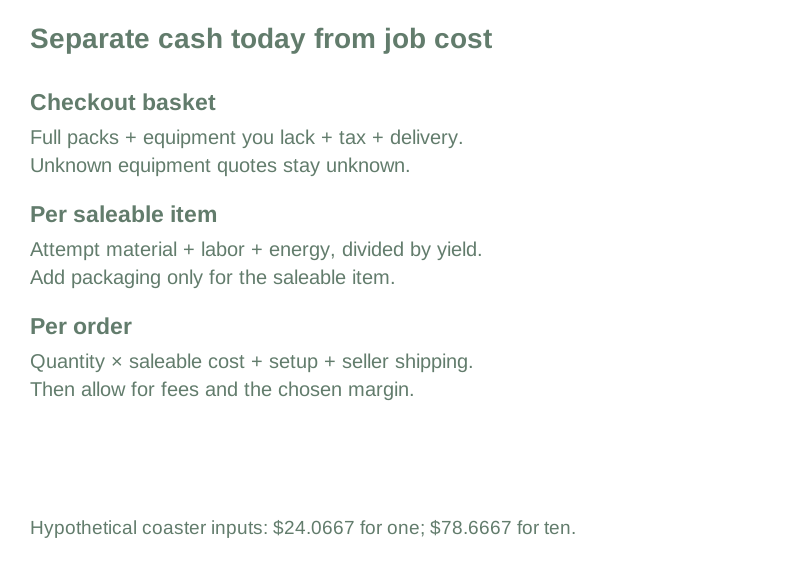
Checkout spending and consumed cost differ
Suppose a blank pack has ten blanks and costs $20. Buying it uses $20 cash; one attempted coaster consumes a $2 blank. Suppose a transfer/protection pack costs $10 and supports ten attempts under your own measured usage: that contributes $1 per attempt. The assumed starter consumable basket is therefore $30, while material consumed in one attempt is $3. Leftover usable stock remains available for later work.
Scroll horizontally to compare all columns.
| Budget view | What belongs in it | Example scope |
|---|---|---|
| Buy from zero | Required reusable equipment plus full consumable packs, spare material, tax and delivery | $30 assumed consumable packs + equipment quote still unknown + tax/delivery still unknown |
| You own all required equipment | Missing consumable packs and any required replacement/accessory | $30 only if both assumed packs are missing; check stock you already own |
| Cost of one production attempt | The share actually consumed, plus attempt labor and energy | $2 blank + $1 transfer/protection + $2 labor + $0.01 energy |
| Cost of the order | Saleable-item costs, one-time setup, shipping and other order costs | Calculated below for one and ten saleable coasters |
There is no complete buy-from-zero total until every equipment/accessory quote and delivery charge is known. “Already owned” changes today’s checkout spending; it does not erase wear, maintenance or the replacement cost of materials. The worked order model assumes no equipment allocation, rent, design license, income tax or other overhead. Add a justified allowance to Other item costs or Other order costs rather than leaving a real expense out.
Enter the complete assumptions
Scroll horizontally to compare all columns.
| Input | One coaster | Ten coasters |
|---|---|---|
| Saleable quantity | 1 | 10 |
| Blank per attempt | $2 | $2 |
| Transfer and protection per attempt | $1 | $1 |
| Production labor | 6 minutes at $20/hour | 6 minutes per attempt at $20/hour |
| Energy | 1,500 W × 2 active minutes at $0.20/kWh | Same per attempt |
| Failed-attempt rate | 10% | 10% |
| Packaging per saleable item | $0.50 | $0.50 |
| Setup labor per order | $10, equivalent to 30 minutes at $20/hour | $10 |
| Seller-paid shipping per order | $8 | $8 |
| Other item and order costs | $0, explicitly excluded in this example | $0, explicitly excluded |
| Transaction fees | 3% of merchandise revenue + $0.30 per order | Same |
| Target margin on merchandise revenue | 30% | 30% |
The two energy minutes are a costing assumption, not a press setting. They omit separately measured preheat and standby energy; add those to order costs when relevant. Six production minutes include assumed handling and making time, independent of the blank’s heat dwell.
Reconcile the calculation
Each attempt costs $3 materials + $2 labor + $0.01 energy = $5.01. A 10% failure allowance leaves 90% yield, so expected attempt cost per saleable item is $5.01 ÷ 0.90 = $5.5667. Add $0.50 packaging for $6.0667 per saleable item.
Scroll horizontally to compare all columns.
| Result | One saleable coaster | Ten saleable coasters |
|---|---|---|
| Expected attempt quantity | 1 ÷ 0.90 = 1.1111 | 10 ÷ 0.90 = 11.1111 |
| Production plus packaging | $6.0667 | $60.6667 |
| Setup and seller-paid shipping | $18 | $18 |
| Order cost before payment fees | $24.0667 | $78.6667 |
| Unit price meeting assumed fee and margin | $36.37, rounded up to cents | $11.79, rounded up to cents |
The exact required price is (order cost + $0.30) ÷ [quantity × (1 − 0.03 − 0.30)]. Calculate with unrounded inputs, then round the required unit price upward to cents. The ten-item price is lower because the same $18 order overhead is spread across more saleable items. This does not establish a volume discount you should offer.
Expected attempts can be fractional in a planning model; a real purchase cannot. The illustrative ten-blank pack is insufficient for eleven or twelve attempts. If buying whole ten-packs, twelve planned attempts require two blank packs, plus enough transfer/protection. Choose spare quantities deliberately: an expected 10% loss rate is not a guarantee that twelve attempts will yield ten successes.
Check the decision before accepting an order
At these assumptions, break-even before a target margin is about $25.13 for the one-off and $8.15 per item for ten. That covers only the listed costs and fees. A 30% target margin differs from a 30% markup on cost. Separately charged shipping, pass-through sales tax and tax/accounting treatment are outside this merchandise-revenue model; record them separately and get appropriate advice for your business.
If the resulting price is above what a buyer will pay, change a real input or decline the job. Do not force the number down by setting your labor to zero. Time one trial, count every failed blank and used sheet, then rerun both quantities. The DTF comparison uses the same calculator to expose the assumptions behind two different garment jobs.
Keep the working sheet
Download the blank cost PDF to gather inputs or the example XLSX to calculate offline. Those files do not contain values you typed on this website. Save the online calculation in Saved plans if you want to return to that entered scenario.
Sources and review date
This lesson was created October 3, 2026. Its original arithmetic is checked against the site’s calculator. All prices, time, failure rate and electricity figures are hypothetical; no current supplier checkout or physical production measurement is claimed.
For a broader business budget, the SBA startup-cost guidance separates one-time expenses from monthly costs and lists common omitted expenses. It supplies business-planning context, not the assumed coaster prices or our calculator results.
Page address: https://makepressrepeat.com/guides/first-project-and-batch-pricing